Visian ICL phakic intraocular lens surgery
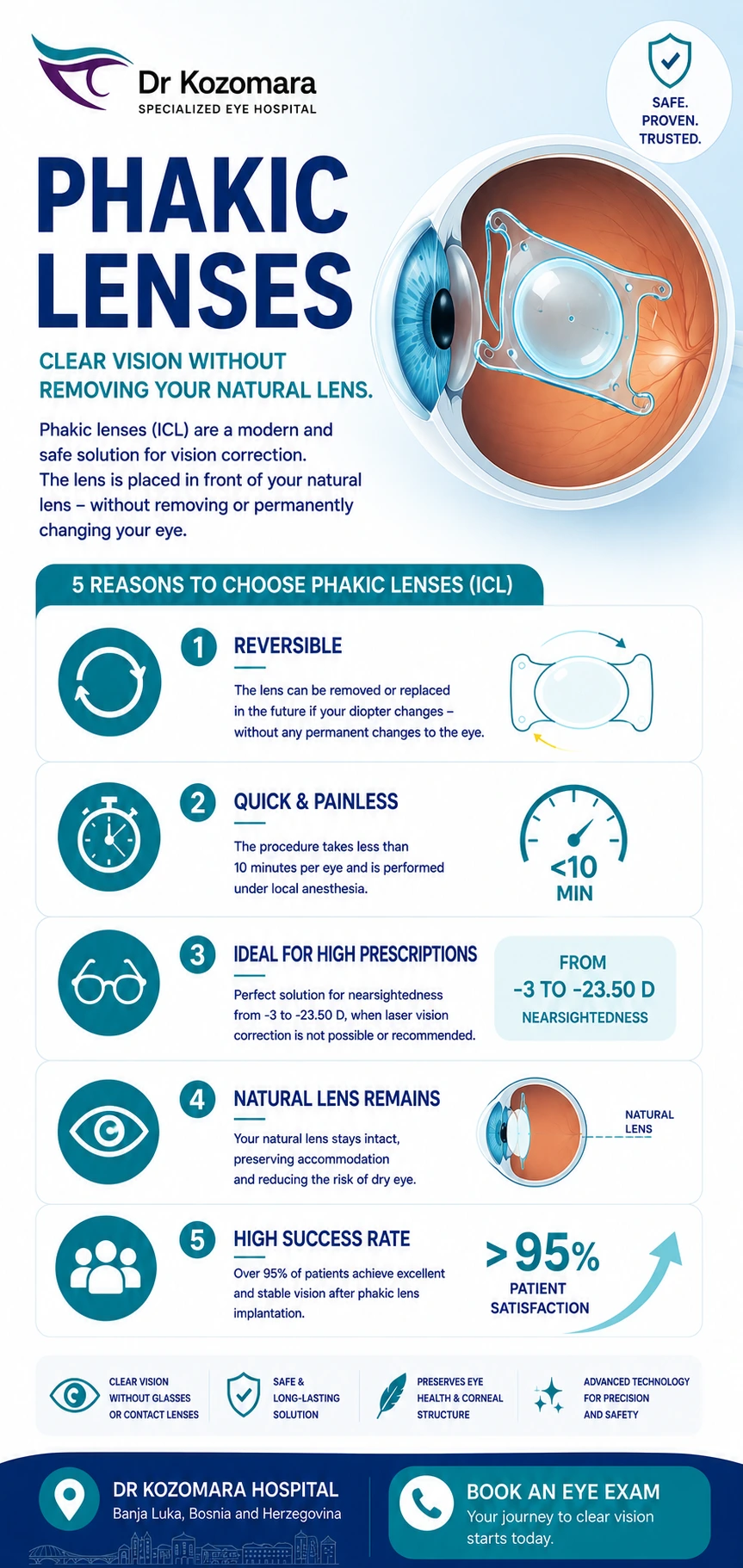
For high prescriptions that laser cannot correct, phakic intraocular lenses (Visian ICL) offer a permanent yet fully reversible solution. Your eye's natural lens stays untouched — the lens is simply implanted behind the iris, in a procedure that takes under 10 minutes.
Phakic intraocular lenses are an excellent alternative to laser vision correction, especially for people who — due to a high prescription or a thin cornea — are not candidates for LASIK or PRK. It is a permanent yet fully reversible solution for correcting your vision.
What are phakic lenses and how are they implanted?
Unlike refractive lens exchange, the natural lens of the eye is not removed with phakic lenses. Instead, a flexible lens is implanted through a small incision (up to 3 mm) behind the iris and in front of the natural lens, where it remains fixed in a precise position. We use the Visian ICL (manufactured by Staar Surgical, USA), made of the biocompatible material Collamer.
What can be corrected?
The Visian ICL corrects a wide range of prescriptions — nearsightedness from -3 to -23.50 dioptres of sphere and astigmatism over -6 dioptres of cylinder — making it a solution even for very high prescriptions.
Who is a candidate?
Between 18 and 45 years of age
A stable prescription for at least 12 months
Not suitable for laser correction (high prescription, thin cornea, etc.)
Healthy eyes, without glaucoma or cataract
A desire for a reversible solution that does not reshape the cornea
What are the procedure and recovery like?
The procedure is performed under anaesthetic drops and takes less than 10 minutes. The flexible ICL is inserted and positioned through an incision of up to 3 mm, followed by a short rest and discharge with a follow-up appointment. Recovery is fast, and more than 95% of treated eyes achieve vision better than 100%.
Advantages and possible risks
The main advantages are reversibility (the lens can be removed or replaced if needed), biocompatibility, fast recovery and preservation of the natural lens. Serious complications are exceptionally rare and may include lens rotation, pupillary block, increased intraocular pressure or retinal detachment.
Have a high prescription or aren't a candidate for laser? Book an appointment at Dr Kozomara Hospital to see whether phakic lenses are the right solution for you.
Everything you need to know about visian icl phakic intraocular lens surgery
ICL suitability criterias
ICL (Implantable Contact Lens) surgery is an ideal option for individuals who:
- Are aged between 21 and 45 years
- Have stable vision within a certain prescription range
- Are not ideal candidates for LASIK or PRK due to factors such as high myopia, thin corneas, or other considerations
- Have healthy eyes free from conditions like glaucoma or cataracts
- Prefer a reversible solution for vision correction.
How ICL works
Implantable contact lenses (ICL) are placed between the eye’s natural lens and the iris. Like traditional contact lenses, they focus light through the lens onto the retina, providing clear vision.
Advantages and disadvantages of ICL
Advantages:
- Alternative to Laser Eye Surgery: ICLs are a great choice if laser surgery isn’t suitable for you or if you have very high prescription needs.
- Reversible Option: Recovery after ICL surgery is quicker than laser surgery, and the lenses can be removed if necessary.
Disadvantages:
- Age Restrictions: ICLs are recommended only for individuals aged 18 to 50.
- Regular Check-Ups: Annual check-ups are required to monitor eye health.
ICL risks
Like any surgery, ICL surgery comes with some rare risks that we will discuss in detail during your consultation. These risks include the lens rotating, blocking the pupil, detachment of the retina, and increased eye pressure (IOP). While these complications are uncommon, it's important to talk about them so you have all the information you need before making your decision.
ICL options and alternatives
We provide ICL surgery when corneal refractive surgery is not suitable or safe. If surgery is not an option, the alternative would be to use glasses or contact lenses.
ICL steps
ICL surgery is an outpatient procedure that takes less than 30 minutes. The surgery consists of several key steps to effectively correct your vision:
- Step 1: Before the procedure, your eye will be numbed with special eye drops. A small incision will be made at the edge of the cornea to insert the lens.
- Step 2: A tiny, foldable lens is inserted through the incision and placed behind the iris, where it will stay permanently.
- Step 3: The lens is adjusted to correct your refractive error, whether it's nearsightedness or astigmatism.
- Step 4 After the surgery, you'll rest briefly before leaving with instructions for follow-up care and check-ups to monitor your healing and vision improvement.
ICL results
ICL surgery often provides remarkable results, significantly improving vision for those with refractive errors. Most patients experience clearer sight almost immediately after the procedure, with many achieving 20/20 vision or better. The lenses are designed to enhance visual acuity while being biocompatible, ensuring a natural fit in the eye. With proper care and regular follow-ups, patients can enjoy long-lasting results, making ICL a popular choice for those seeking a reliable solution to their vision challenges.
Gallery
Learn how other people overcame their dependence, and find out how you can, too
Join thousands who have achieved freedom from glasses and contacts
Academic resources on ICL
Expand your knowledge about ICL. (These links will take you away from our website.)
The Visian V4c ICL offers a highly effective solution for the correction of moderate to high myopia, with more than 95% of eyes achieving vision and better than 100%. With no complications or cataract development, this latest version of the ICL lens is proving to be much better than previous models, making it a very reliable solution for the correction of myopia.
Phakic intraocular lenses (ICLs) offer an excellent alternative to LASIK for people with moderate to high myopia. With high patient satisfaction and extremely few complications, these implantable lenses provide permanent, clear vision without the need for glasses or contact lenses. Discover the benefits and results of Visian ICL for excellent myopia correction outcomes.
Click here for more information.
FAQs and information about vision correction
Everything you need to know about our practice and procedures