
PRK
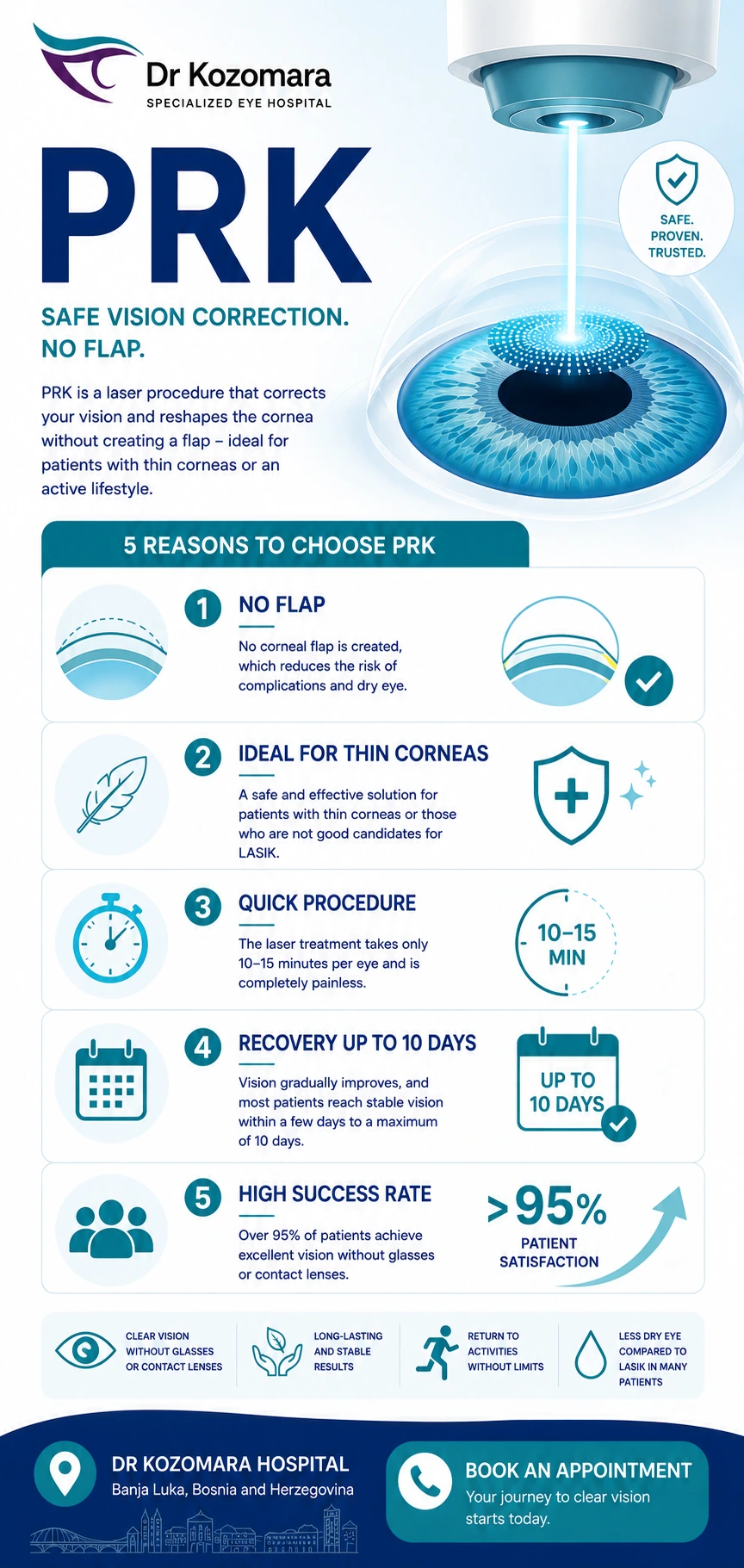
PRK is the first and one of the most proven methods of laser vision correction, especially suited to patients with a thinner cornea who aren't candidates for LASIK. No flap is created — the surface of the cornea itself is reshaped, using the modern T-PRK "No-Touch" technique with no instrument contact at all.
PRK is the first and one of the most proven methods of laser vision correction. Unlike LASIK, PRK does not create a corneal flap — instead, the surface of the cornea is reshaped, which makes it particularly suitable for patients with a thinner cornea.
What is PRK and how does it differ from LASIK?
In PRK, a thin surface layer of the cornea (the epithelium) is first removed, after which the laser microscopically reshapes the cornea and corrects the refractive error. With the modern transepithelial PRK (T-PRK, "No-Touch") technique, even the epithelium is removed by the laser, without any instrument contact. A protective contact lens is then placed on the eye to aid healing. PRK corrects nearsightedness, farsightedness and astigmatism.
Who is a candidate for PRK?
PRK is the method of choice for thinner corneas and when other laser methods are not advisable. It achieves the best results for corrections up to -4 dioptres of sphere and -2 dioptres of cylinder, and is not recommended for plus (farsighted) prescriptions. The final assessment is made after a detailed pre-operative examination.
Advantages and disadvantages
Advantages: there are no incisions or flap, so there are no flap-related complications, and the StreamLight Trans-PRK technique allows a no-touch procedure. Disadvantages: recovery is longer and less comfortable — up to 10 days — the correction range is limited, and there is a somewhat higher chance of partial regression of the prescription.
Results and recovery
After full recovery, most patients achieve 95% vision or better. Clearer vision is noticeable within a few days, while the full result appears after several weeks, once the cornea has completely healed. As with all laser methods, temporary effects such as glare or dry eye are possible.
PRK combined with CXL for keratoconus
In patients with keratoconus, PRK can be combined with corneal collagen cross-linking (CXL), which at the same time stabilises the progression of the disease and partially corrects the prescription, while preserving corneal stability.
Have a thinner cornea or aren't a candidate for LASIK? Book an appointment at Dr Kozomara Hospital and see whether PRK suits you.
Everything you need to know about prk
PRK suitability criteria
Photorefractive Keratectomy (PRK) is the first laser vision correction technique. This method is based on the removal of the epithelium (the surface part of the cornea) with a laser (Transepithelial PRK; T-PRK) and diopter correction through ablation (micron-scale remodeling) of the corneal stroma. It is suitable for corrections up to -4 diopters of the sphere and up to -1.50 diopters of the cylinder, while it is not recommended for the correction of + diopters. It is primarily advised for patients who have thin corneal tissue and for whom other diopter correction methods are not advisable.
How PRK works
PRK (Photorefractive Keratectomy) is a laser vision correction procedure that reshapes the cornea to improve vision. First, the outer layer of the cornea is gently removed to expose the tissue underneath. A laser is then used to reshape the cornea, correcting nearsightedness, farsightedness, or astigmatism. After the procedure, a protective contact lens is placed on the eye to aid healing. PRK is ideal for patients with thin corneas or those who may not qualify for LASIK.
Advantages and disadvantages of PRK
Advantages:
- PRK can help people who have thin front parts of the eye, called corneas
- PRK is good for people with corneas that are not the usual shape
Disadvantages:
- The drawback of this method is a somewhat longer postoperative recovery. Specifically, the regeneration of the corneal epithelium that is removed during the surgery can take up to 10 days, which may cause the patient to experience blurred vision, irritation, and tearing.
PRK risks
After PRK, your vision with glasses may not be as sharp as it was before.
You might notice halos or double vision at night, and your eyes could feel dry, sometimes for an extended period.
Over time, or as you age, the results of the surgery may diminish, particularly if you already have difficulty seeing distant objects.
PRK options and alternatives
If PRK isn’t suitable for you, other vision correction options are available.
LASIK is a popular alternative, where a flap is created on the cornea before reshaping it with a laser.
FemtoLASIK is another minimally invasive laser procedure.
For those who are not good candidates for laser surgery, lens-based solutions like lens replacement surgery can offer improved vision without reshaping the cornea.
PRK results
PRK typically results in significantly improved vision, with many patients achieving 20/20 vision or better after healing. While recovery takes longer than LASIK, most individuals begin to notice clearer vision within a few days, with full results appearing in a few weeks. The reshaped cornea permanently improves vision, reducing or eliminating the need for glasses or contact lenses. For many, PRK offers long-lasting clarity and freedom from corrective eyewear.
Gallery
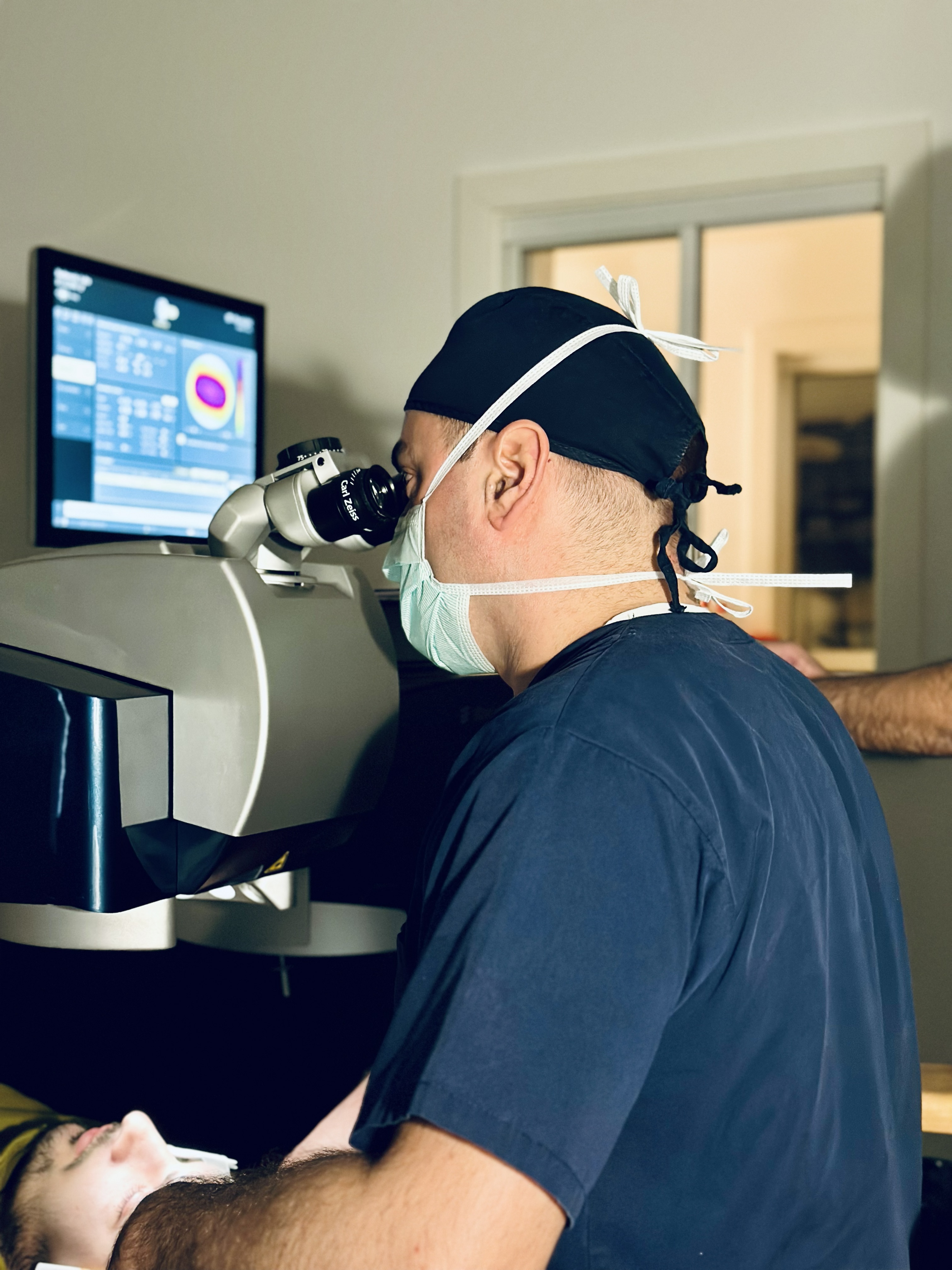
Learn how other people overcame their dependence, and find out how you can, too
Join thousands who have achieved freedom from glasses and contacts
Academic resources on PRK
Expand your knowledge about PRK. (These links will take you away from our website)
Recent studies show that photorefractive keratectomy (PRK) achieves better results than corneal crosslinking (CXL) in patients with low myopia. PRK effectively corrects refractive errors and improves visual acuity, resulting in faster recovery and lower complication rates compared to CXL, which is mainly used for keratoconus. This makes PRK the preferred option for individuals seeking vision improvement in low myopia.
Photorefractive keratectomy (PRK) is laser surgery that changes the shape of the cornea to correct refractive errors, such as myopia, and partially astigmatism. Unlike LASIK, PRK involves removing the outer layer of the cornea (epithelium) before the laser is applied to the underlying tissue. This technique may be useful for patients with thin corneas or those at risk of flap complications. Although recovery may take longer than with LASIK, PRK offers a safe and effective alternative to improving vision.