
Femto-Lasik
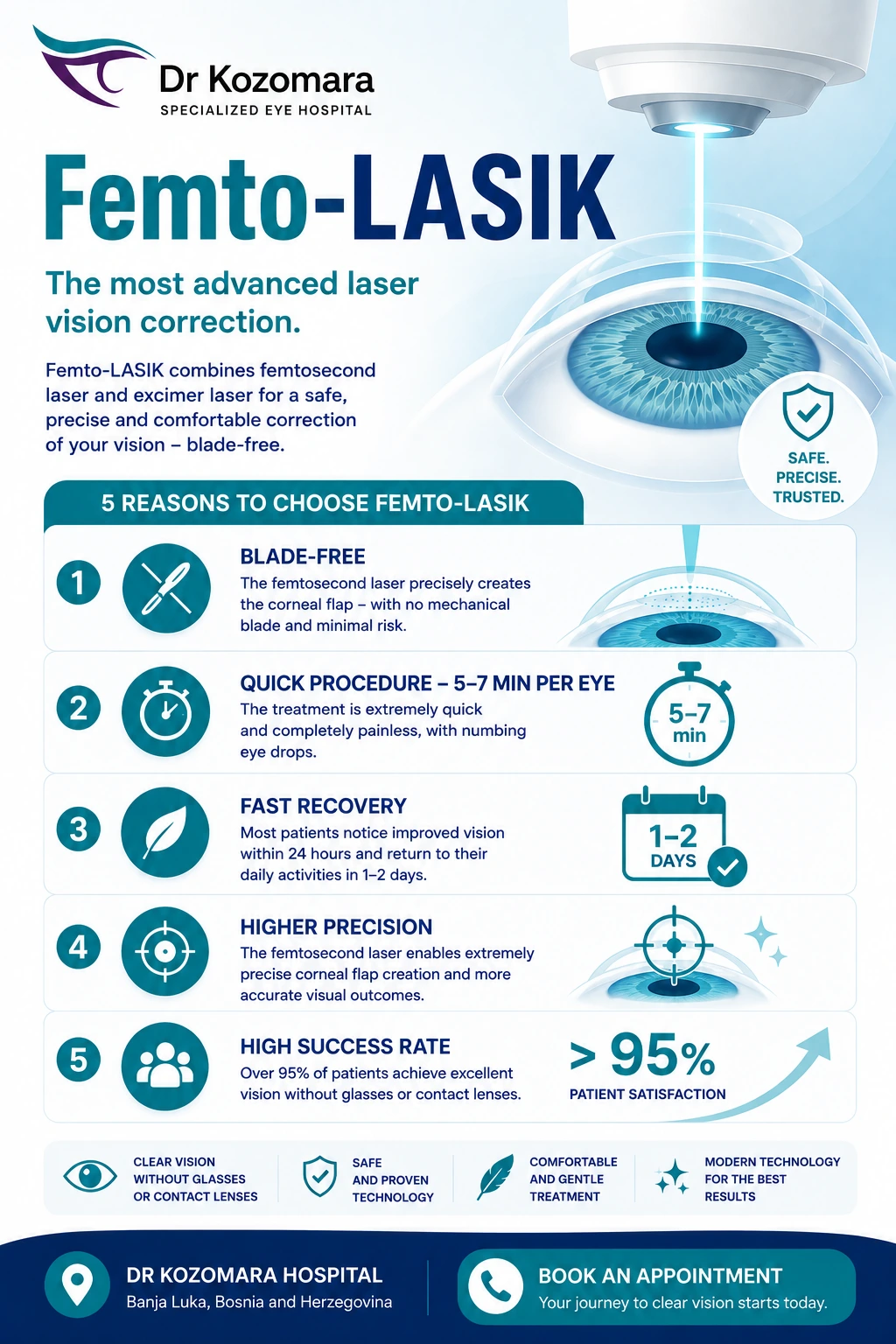
Femto-LASIK is a modern advancement of classic LASIK, where the corneal flap is created completely blade-free — using the SCHWIND ATOS femtosecond laser. This brings greater precision and safety, with a procedure of just 5–7 minutes per eye and recovery in only 1–2 days.
Femto-LASIK is a modern, minimally invasive method of laser vision correction that lets you live without glasses and contact lenses. It is an advancement of the classic LASIK method and becomes more sought-after year after year.
How does Femto-LASIK differ from classic LASIK?
In classic LASIK, the thin corneal flap is created with a microkeratome (a specialised blade). In Femto-LASIK, that flap is created with a femtosecond laser, completely blade-free, which brings greater precision and safety. The rest of the correction is performed exactly as in LASIK — with a second laser that reshapes the cornea according to your prescription.
Advanced technology
We perform the procedure with the SCHWIND ATOS femtosecond laser featuring SmartSight technology — a CE-approved device designed for minimally invasive refractive procedures, which further improves precision and safety and shortens recovery time.
What is the procedure like?
After a detailed pre-operative examination confirming that you are a candidate, anaesthetic drops are applied to the eye. The femtosecond laser creates a thin corneal flap that is gently lifted, and a second laser reshapes the cornea and corrects the refractive error. The flap is then repositioned without sutures. The procedure takes approximately 5–7 minutes per eye.
Advantages and disadvantages
Advantages: a precisely created flap, reduced risk of complications, minimal discomfort during the procedure and fast recovery — most patients see an improvement within a few days. Disadvantages: a higher cost than classic LASIK, the need for thorough pre-operative examinations, and the fact that not all patients are candidates.
Who is a candidate?
Candidates are people with a healthy cornea of sufficient thickness. Before the procedure we rule out conditions such as glaucoma, cataract and keratoconus, while autoimmune diseases and uncontrolled diabetes may make the method inadvisable.
Results and recovery
Recovery is fast — most patients return to their usual activities within 1–2 days, and the vast majority achieve 100% vision or better within a few days. The results are stable and long-lasting. As with other methods, reading glasses may become necessary after the age of 45. We recommend regular follow-up examinations.
Interested in Femto-LASIK? Book an appointment at Dr Kozomara Hospital and find out whether you are a candidate.
Everything you need to know about femto-lasik
FemtoLASIK suitability criteria
FemtoLASIK is suitable for individuals aged 18 or older with stable refractive errors such as myopia, hyperopia, and astigmatism.
Candidates should have healthy corneas and sufficient corneal thickness to support the procedure.
A comprehensive eye exam is essential to rule out conditions like glaucoma, cataracts, or keratoconus.
Additionally, those with certain medical conditions, such as autoimmune disorders or uncontrolled diabetes, may not qualify.
A thorough consultation with an ophthalmologist will help determine individual suitability for FemtoLASIK.
How FemtoLASIK works
Creating a flap on the surface of the cornea can be done in two ways: with a microkeratome (a specially designed blade) or with a laser. Femto-LASIK employs the latter method, creating the flap with a laser rather than a blade. Although there is ongoing controversy over whether the Femto option is genuinely better than the microkeratome, the preference for the Femto method has been increasing year by year. The rest of the diopter correction process is the same for both procedures.
Advantages and disadvantages of FemtoLASIK
Advantages:
FemtoLASIK offers numerous advantages;
- Including precise corneal reshaping,
- Reduced risk of complications
- Minimalnu nelagodu tokom postupka
- Most patients experience rapid recovery and improved vision within days.
Disadvantages:
Disadvantages may include:
- The cost, which can be higher than traditional LASIK
- The need for thorough preoperative evaluations
- Additionally, not all patients are suitable candidates
- Some may still require glasses for certain activities after surgery.
FemtoLASIK risks
While FemtoLASIK is generally safe, some risks are associated with the procedure.
Patients may experience dry eyes, glare, halos, or double vision, particularly at night.
There’s also a chance of under-correction or over-correction of vision, requiring additional enhancements.
In rare cases, complications like infections or scarring can occur.
Additionally, if patients have unrealistic expectations regarding results, they may feel dissatisfied.
It's vital to discuss potential risks with an ophthalmologist to ensure an informed decision.
FemtoLASIK options and alternatives
FemtoLASIK is one of several refractive surgery options available.
Alternatives include traditional LASIK, PRK, and lens replacement surgery.
Traditional LASIK uses a microkeratome to create the corneal flap, while PRK reshapes the cornea's surface without creating a flap.
Lens replacement surgery involves replacing the eye's natural lens with an artificial one.
Each option has its benefits and drawbacks, so it's crucial to consult with an eye specialist to determine the best choice based on individual vision needs and lifestyle.
FemtoLASIK steps
- The FemtoLASIK procedure begins with a comprehensive eye examination to determine suitability
- Once confirmed, numbing eye drops are applied
- A femtosecond laser is used to create a thin corneal flap, which is then gently lifted
- A second laser reshapes the cornea to correct refractive errors
- After the reshaping is complete, the flap is repositioned without the need for stitches.
The entire process typically takes about 10-15 minutes per eye, and patients can often resume normal activities shortly after.
FemtoLASIK results
Most patients experience rapid improvement in vision after FemtoLASIK, with many achieving 20/20 vision or better within days. The results are typically stable and long-lasting, allowing for reduced dependence on glasses or contact lenses. Some may still require reading glasses as they age, but overall satisfaction rates are high. Regular follow-up appointments ensure optimal healing and can address any concerns. FemtoLASIK provides patients with enhanced visual clarity and quality of life, making it a popular choice for vision correction.
Gallery
Learn how other people overcame their dependence, and find out how you can, too
Join thousands who have achieved freedom from glasses and contacts