LASIK
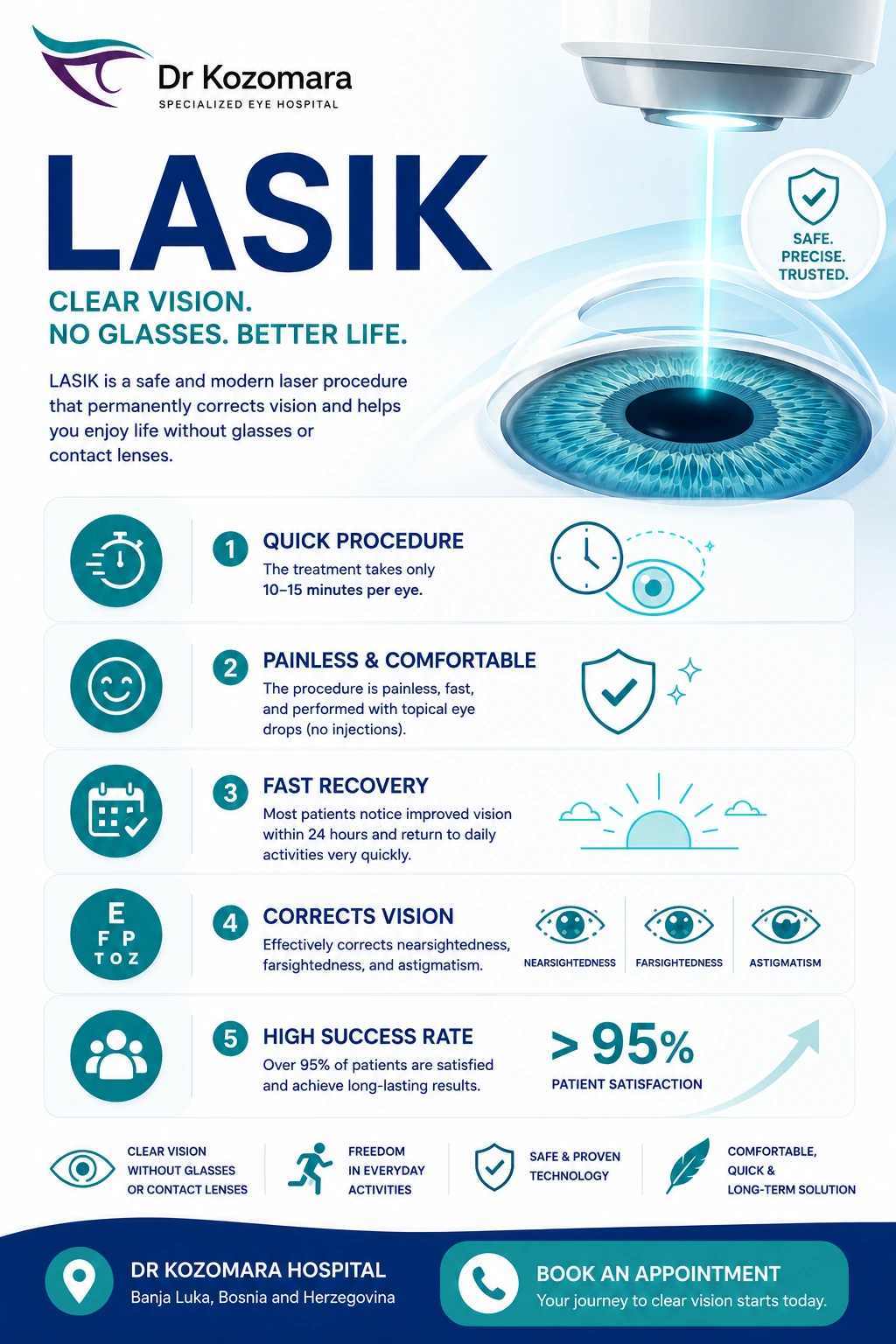
LASIK is the best known and most frequently performed method of laser vision correction in the world. By reshaping the cornea, it restores sharp vision and reduces your dependence on glasses and contact lenses. The procedure is quick, painless, and recovery is fast — many patients notice clearer vision as soon as the next day.
LASIK (Laser-Assisted In Situ Keratomileusis) is the best known and most frequently performed method of laser vision correction in the world. By reshaping the cornea, it allows light to focus properly on the retina again, correcting nearsightedness, farsightedness and astigmatism and reducing dependence on glasses and contact lenses.
What is LASIK and how is it performed?
During the procedure, a thin flap is first created on the surface of the cornea. An excimer laser then reshapes the deeper corneal layer with great precision according to your prescription, after which the flap is returned to its place and heals naturally, without sutures. The procedure itself is short and painless, using anaesthetic drops.
Who can be a candidate for LASIK?
At least 18 years of age, with a stable prescription for at least one year
Sufficient corneal thickness and a regular corneal shape
No active infection, inflammation or severe dry eye
No conditions that impair healing, and realistic expectations
LASIK is not recommended in cases of a very thin or irregular cornea, pronounced dry eye, certain eye diseases, during pregnancy and breastfeeding, or with uncontrolled systemic diseases. In such cases we consider PRK or a phakic intraocular lens.
LASIK or Femto-LASIK?
In standard LASIK the flap is created with a microkeratome, while with Femto-LASIK it is created with a femtosecond laser. Which method is right for you is best determined after a detailed pre-operative examination.
Recovery and results
After LASIK, most patients notice clearer vision very quickly and return to daily activities fast. Keep in mind that no method guarantees complete independence from glasses in every situation, and the result depends on your initial prescription, the condition of the cornea, your age and the characteristics of your eye.
Price of the LASIK procedure
The price of LASIK laser vision correction is 1800 KM per eye. The full price list is available on our prices page.
Considering LASIK to correct your vision?
Book an appointment at Dr Kozomara Hospital and find out whether you are a candidate.
Everything you need to know about lasik
LASIK suitability criteria
LASIK is an option for people who:
- Want to see clearly without relying on glasses or contacts
- Are 18 years or older
- Have had a stable prescription for at least one year
- Have healthy eyes without major issues
- Don’t have conditions like glaucoma or cataracts
- Do not have thin corneas (will be checked on the preoperative exam)
What is same-day LASIK?
Same-day LASIK is a streamlined vision correction process that allows patients to have their consultation and LASIK procedure on the same day. Instead of multiple visits, you can undergo a thorough eye examination in the morning and, if eligible, proceed with LASIK that same afternoon.
This approach eliminates unnecessary delays, making vision correction faster and more convenient. It’s especially ideal for those with busy schedules or travelling from outside the area, allowing them to complete their procedure in just one visit.
With advanced laser technology and expert surgeons, you can experience safe, precise, and life-changing vision correction—all in one day!
How LASIK works
Currently, the most popular and frequently used method of laser vision correction is Laser Assisted In Situ Keratomileusis (LASIK).
This method corrects your vision perfectly in up to 95% of cases, which currently makes it the most popular procedure in laser vision correction.
Unlike the PRK method, in LASIK, the epithelium is not removed. Instead, a flap is created on the surface of the cornea through an incision. This flap is lifted from the cornea, the stroma is reshaped with a laser to correct the diopter, and then the flap is placed back in its original position on the eye.
Due to this method of diopter correction, LASIK can correct minus diopters up to -9, plus diopters up to +4, and astigmatism up to ±5 diopters.
Another advantage of LASIK is the significantly faster postoperative recovery. Patients can return to most of their daily activities within 1-2 days after the procedure, with virtually no pain, blurred vision, or eye tearing.
Advantages and disadvantages of LASIK
Advantages:
- LASIK is highly precise and effectively corrects vision
- The procedure is painless
- Recovery is quick
- Your vision improves significantly
- It can correct both near and far vision issues, as well as irregularly shaped eyes
- If needed, a second LASIK surgery can be easily performed
Disadvantages:
- The procedure involves creating a small flap on the eye, which can occasionally lead to complications. This flap could shift, become infected, or develop skin cells underneath it.
LASIK risks
Like any surgery, LASIK comes with some risks.
Serious but very rare risks include:
- Your vision could worsen even with glasses
- The clear front part of your eye could change shape in an unfavourable way
- The clear front part of your eye could develop an infection.
Minor risks include:
- Your eyes may feel dry
- You might have difficulty seeing at night, such as seeing halos around lights
- Your eyes might gradually return to their previous condition, and you may need glasses or another LASIK surgery in the future.
LASIK options and alternatives
If LASIK isn’t the right option for you, there are other alternatives to consider. PRK (Photorefractive Keratectomy) is an excellent choice for those with thinner corneas. Another option is FemtoLASIK, which offers a minimally invasive approach. Lens replacement surgery can be ideal for people with severe vision issues. Each option has its own benefits, and your eye doctor will help determine the best solution based on your unique needs.
LASIK steps
Step 1: We’ll apply special drops to numb your eye. Once the drops take effect, we’ll use a tool to gently keep your eye open
Step 2: Using a precise laser, we create a small flap on the clear front part of your eye
Step 3: You’ll then be moved to a different laser
Step 4 We carefully lift the flap to reveal the inner layer of the clear front part of your eye
Step 5: The new laser reshapes the inner layer of the clear front part of your eye to improve your vision
Step 6: We reposition the flap, which acts as a natural bandage to protect your eye.
LASIK results
LASIK eye surtery bring happiness to many people because it helps them see sharply. After LASIK, most patients have the same vision as if they are wearing their prescription glasses, but without the need for them. They all get 100% of vision or better, which is an excellent result.
Almost everyone reaches at least 20/40 vision or better (the standard for driving). How much your vision improves depends on how your eyes were before surgery.
If the initial results don’t meet expectations, you may qualify for a free enhancement procedure.
Some people might still need glasses or contact lenses after the surgery, but with a much weaker prescription. Their vision will be greatly improved, but they might need a little help for perfect clarity.
With LASIK, life gets simpler. You can wake up and see the clock without searching for your glasses. You can enjoy sports, swimming, and outdoor activities without worrying about your glasses or contacts. Seeing clearly from morning to night feels amazing. This surgery opens up a world where your vision supports your freedom, making every day more enjoyable.
Gallery
Pricing for lasik
| Service | Price |
|---|---|
|
LASIK (per eye)
|
900 EUR |
Learn how other people overcame their dependence, and find out how you can, too
Join thousands who have achieved freedom from glasses and contacts
Academic resources on LASIK
Expand your knowledge about LASIK. (These links will take you away from our website.)
In 2009, the FDA, NEI, and DoD launched the LASIK Quality of Life Collaborative Project (LQOLCP) to evaluate the potential risks of LASIK surgery. This study developed tools to monitor patient-reported outcomes (PROs), assessing visual symptoms and their impact on daily life before and after surgery. Although the results showed a high level of patient satisfaction, some minor visual symptoms were noted after surgery.
The checklist advises patients to discuss vision goals, review costs, assess the surgeon's qualifications and consider risks before refractive surgery.
Refractive surgery includes various procedures designed to change the shape of the cornea, reducing the need for glasses or contact lenses. LASIK specifically targets refractive errors such as myopia (nearsightedness), hypermetropia (farsightedness) and astigmatism, helping patients achieve clearer vision.